Tranexamic Acid for Skin: What Is It?
SEO Team · 4 November 2026
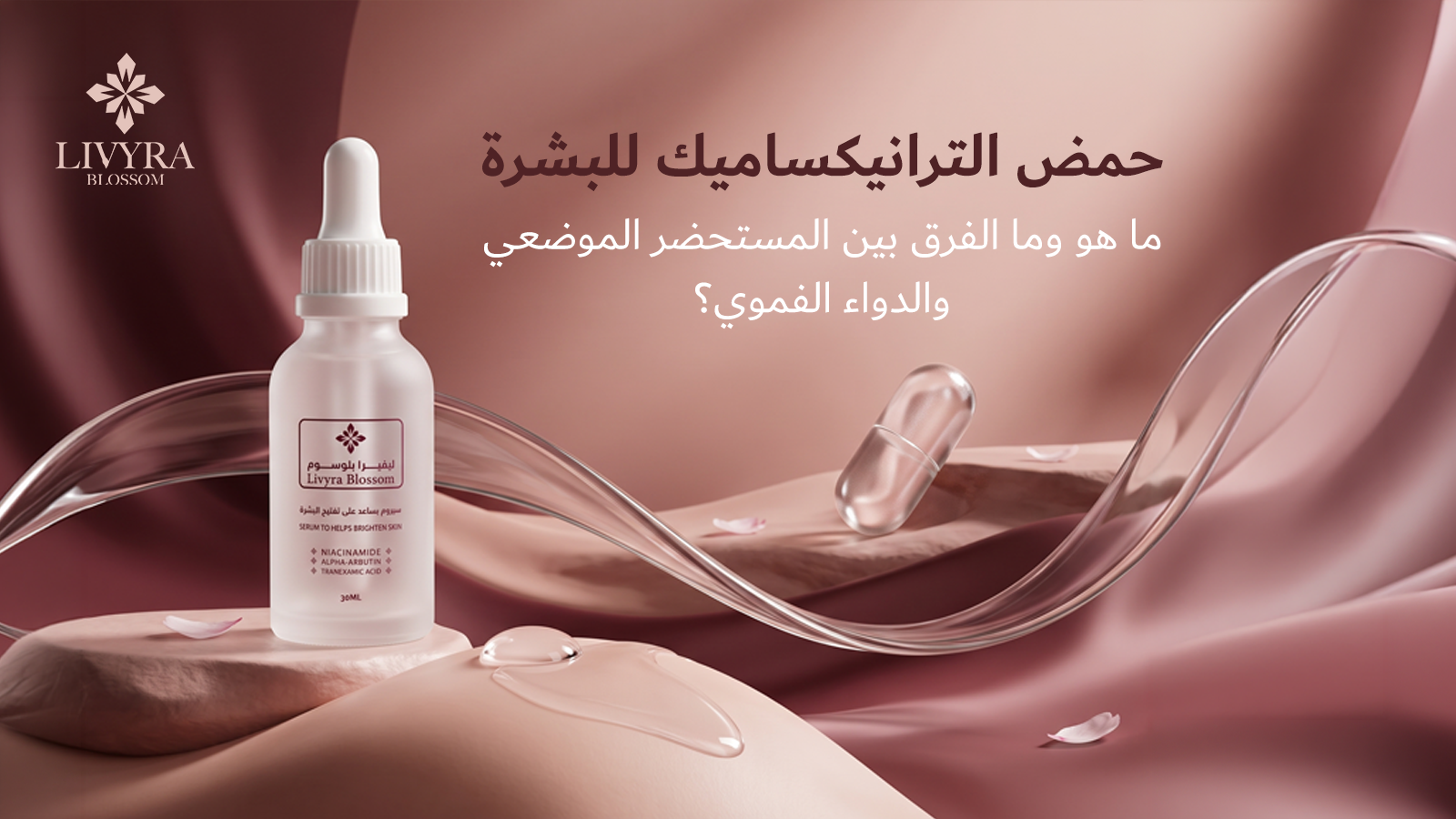
Tranexamic Acid for Skin: What Is It and What Is the Difference Between Topical Products and Oral Medication?
The name tranexamic acid for skin frequently appears on social media and serum packaging, often leaving readers confused: Is it a medication or a cosmetic ingredient? Are the tablets prescribed by doctors the same as the product applied to the face? The short answer is that although they share the same name, they differ in form, concentration, purpose, medical supervision, and potential risks.
In this article, we explain Tranexamic Acid in simple terms, how it is studied in pigmentation care, the fundamental differences between topical tranexamic acid and oral tranexamic acid, what research says and does not say, and when you should consult a dermatologist. This content is for educational purposes only and does not constitute a diagnosis or medical prescription.
If you would first like to understand the different types of dark spots, read our guide to Types of Facial Pigmentation to learn which type may apply to your skin.
What Is Tranexamic Acid for Skin?
Tranexamic acid is a synthetic derivative of lysine, an amino acid. Medically, it is known as an antifibrinolytic agent, meaning it helps prevent the breakdown of blood clots. For this reason, it is used in medical situations where reducing bleeding is the goal, such as heavy menstrual bleeding and certain surgical procedures. This is its original medical use, and it requires medical supervision.
Researchers later began studying it in dermatology, particularly for pigmentation concerns. Scientific reviews describe the use of oral tranexamic acid for resistant melasma as an off-label use, meaning that doctors prescribe it based on their professional judgment rather than its primary approved indication. In addition, the ingredient has become part of topical cosmetic formulations designed to improve the appearance of uneven skin tone.
Three Forms of Tranexamic Acid: Which One Is Used in Skincare?
When reading about tranexamic acid, you may be referring to one of three forms, each with completely different considerations.
Oral Tranexamic Acid: A Medication That Requires Medical Supervision
These are prescription tablets. A doctor prescribes them after evaluating your condition and medical history because medication taken orally affects the entire body, not just the skin.
Reviews indicate that common side effects reported in studies are generally mild, such as gastrointestinal disturbances and menstrual changes. They also report no significant increase in blood clot risk when patients with contraindications are excluded. This means that safety depends on proper medical screening and is not an absolute characteristic of the medication.
For this reason, taking oral tranexamic acid to lighten facial skin without consulting a doctor is unsafe, even if it appears to be a common practice in social media videos. Do not use leftover tablets from a previous treatment or purchase the medication from unreliable online sources.
Topical Tranexamic Acid: A Product Applied Directly to the Skin
This is the form found in many cosmetic serums and creams. It is applied directly to the skin at a concentration determined by the manufacturer, with the purpose of improving the appearance of the skin rather than providing medical treatment.
The most commonly reported side effects of topical tranexamic acid in studies include redness and irritation. These reactions vary from person to person and depend on the overall formulation.
Intradermal Tranexamic Acid: A Clinical Procedure
This form is administered through injections into the skin by a qualified professional in a clinical setting. It is never a procedure to perform at home.
The key takeaway is that these forms are not interchangeable. Findings from studies involving oral tablets or injections cannot automatically be applied to cosmetic topical products, and vice versa. Topical products do not replace medical evaluation or prescription treatment when necessary.
What Does Research Say About Tranexamic Acid and Pigmentation?
A recent scientific review published in 2026 in the Journal of Cosmetic Dermatology, examining tranexamic acid for melasma and post-inflammatory hyperpigmentation, concluded that oral, topical, and intradermal forms reduced pigmentation indicators in clinical studies.
It also reported that topical tranexamic acid demonstrated effectiveness comparable to hydroquinone in some comparisons, with less irritation.
You can explore Research on Tranexamic Acid for Melasma and Post-Inflammatory Pigmentation yourself. However, these findings should be interpreted carefully for five reasons:
- The review is narrative: It brings together different studies, some of which are small, and does not carry the same strength of evidence as one large clinical trial.
- Concentrations and treatment durations vary between studies, as do the accompanying formulations.
- Some studies combined tranexamic acid with other treatments, such as laser procedures or additional ingredients, making it difficult to attribute improvements to tranexamic acid alone.
- Melasma itself tends to recur even after improvement, particularly with sun exposure.
- The results of a specific product cannot be predicted from these findings alone, because outcomes depend on the complete formulation, concentration, and individual skin condition.
In other words: Research makes tranexamic acid an ingredient worth considering, but it does not guarantee results from any particular product.
Is Tranexamic Acid Safe for the Skin?
The question "Is tranexamic acid safe for the skin?" cannot be answered with an absolute yes or no. In studies, topical tranexamic acid was generally well tolerated, with redness and mild irritation being the most commonly reported side effects. However, tolerability depends on several factors:
- The complete product formulation: Tranexamic acid is rarely used alone. A product may contain acids or other ingredients that affect skin sensitivity.
- Your skin condition: Sensitive, irritated, or damaged skin may react to any active skincare ingredient.
- Pregnancy and breastfeeding: Consult your doctor before using any pigmentation skincare product during these periods.
- Following product instructions: This includes the recommended amount, frequency, and application timing.
Always patch-test a new product on a small area first. Stop using it if irritation occurs, and do not rely on marketing claims such as "safe for everyone."
Tranexamic Acid and Niacinamide: Why Are They Often Used Together?
You will often find tranexamic acid alongside niacinamide in pigmentation serums. Niacinamide is a form of vitamin B3 used to support skin radiance, improve the appearance of uneven skin tone, and support the skin barrier.
The two ingredients are combined because each serves a different role within the same formulation. Their combination has been investigated in some studies, but this does not mean that every product containing both ingredients will deliver identical results.
If you use niacinamide alongside other acids, read our article about Niacinamide with Acids to understand how to combine them gently and which mistakes to avoid.
Which Types of Pigmentation Are Studied with Tranexamic Acid?
Most research focuses on two types of pigmentation: melasma and post-inflammatory hyperpigmentation.
Melasma is a condition that requires evaluation by a dermatologist because identifying its type and underlying causes influences the appropriate approach. It is also known for its tendency to recur.
Post-inflammatory hyperpigmentation refers to the dark marks left behind by acne, wounds, or other skin inflammation. You can learn more in our article about Post-Acne Dark Marks.
Other concerns include sunspots and general uneven skin tone, which primarily require consistent daily sun protection.
The most important thing to understand is that topical skincare targets the appearance of pigmentation. If the discoloration is deep or the condition is complex, you may need professional evaluation and treatment options beyond what a serum can offer.
How to Safely Incorporate Tranexamic Acid into Your Skincare Routine
The first rule is to follow the instructions of the specific product you are using, as formulations differ. In addition:
- Start with a patch test on a small area before applying the product to your entire face.
- Avoid introducing multiple active ingredients at once, especially exfoliating acids, retinol, and vitamin C, unless the product instructions allow it.
- Never skip daily sun protection. Sun exposure can darken existing spots and delay visible improvement.
- Give your routine enough time: Improvements in studies are generally measured over weeks to months. Consistency matters more than quantity.
- Stop using the product if irritation occurs. Do not continue on the assumption that your skin simply needs time to adjust.
To learn how to organize your morning and evening skincare steps, read our Pigmentation Skincare Routine.
For a broader overview of pigmentation serums and their ingredients, explore our Dark Spots and Even Skin Tone Serum Guide.
Common Mistakes to Avoid
- Taking tranexamic acid tablets to lighten the skin without a prescription or medical evaluation, as this is a medical use with potential risks.
- Crushing tablets and applying them directly to the face as a homemade treatment. There is no established safe basis for this practice, and the concentration and purity are unknown.
- Assuming that a stronger ingredient means faster results. Irritation may actually worsen pigmentation.
- Relying on tranexamic acid while neglecting sunscreen.
- Comparing your results with other people's experiences on social media. Results vary depending on skin type, the underlying cause, and the product formulation.
When Should You Consult a Dermatologist?
Medical consultation is recommended in the following situations:
- Suspected melasma or pigmentation spreading across large areas of the skin.
- A new spot that changes rapidly in size, color, or shape, or has irregular borders.
- Pigmentation that appears after starting a new medication, during pregnancy, or alongside hormonal changes.
- Persistent irritation, itching, or peeling after using a product.
- No noticeable improvement despite following a consistent skincare and sun protection routine for a reasonable period.
- If you want to know whether oral tranexamic acid is suitable for you. This is a medical decision that must be made after evaluating your condition.
Frequently Asked Questions About Tranexamic Acid for Skin
What Is Tranexamic Acid for Skin?
It is a synthetic derivative of the amino acid lysine. It is medically used to reduce bleeding and has also been investigated in dermatological research on pigmentation. It is found in topical cosmetic products designed to improve the appearance of uneven skin tone.
What Is the Difference Between Topical and Oral Tranexamic Acid?
Oral tranexamic acid is a prescription medication that affects the entire body and requires medical supervision. Topical tranexamic acid is a product applied directly to the skin to improve its appearance. They differ in purpose, concentration, and risks, and neither form replaces the other.
Can I Take Tranexamic Acid Tablets to Lighten My Skin?
Do not take these tablets without consulting a doctor. Your doctor must evaluate your medical history and condition before deciding whether this medication is appropriate for you.
Is Tranexamic Acid Safe for the Skin?
In studies, topical tranexamic acid was generally well tolerated, with redness and irritation being the most common side effects. Its safety depends on the complete formulation and your skin condition. Patch-test the product on a small area and stop using it if irritation occurs.
Can Tranexamic Acid Be Used with Niacinamide?
They are commonly found together in skincare formulations, and their combination has been investigated in research. Follow the product instructions and avoid adding other active ingredients without checking their compatibility.
Does Tranexamic Acid Remove Melasma?
No product can guarantee this result. Melasma is a condition that tends to recur and requires evaluation by a dermatologist. Topical products target the appearance of pigmentation as part of a skincare routine that includes sun protection.
When Do Topical Tranexamic Acid Results Appear?
Results vary from person to person. Studies generally measure improvements over weeks to months. Consistency and daily sun protection are more important than any single application.
Tranexamic Acid
Tranexamic acid for skin is an ingredient that has undergone serious dermatological research, but it comes in three forms that serve different purposes: oral medication under medical supervision, topical products for cosmetic care, and clinical injections.
Research findings are encouraging but should be interpreted carefully, and they do not establish the effectiveness of any specific product. The essential safety rules are simple: never take oral tablets without medical supervision, patch-test topical products, and maintain daily sun protection.
In this context, Livyra Blossom Serum contains 3% tranexamic acid as part of a formulation that includes 4% niacinamide, 2% alpha arbutin, and glycolic and salicylic acids.
It is a cosmetic product designed to improve the appearance of pigmentation and uneven skin tone, not a medication.
It should be used in the evening only, applying 2–3 drops to the face and neck. It should not be used daily unless directed by a dermatologist or skincare professional. It is not suitable for pregnant women or sensitive or irritated skin. Breastfeeding women should consult a doctor before use.
This article is intended for general educational purposes only and does not replace individual medical consultation, diagnosis, or treatment.